Freshwater Cisterns Alberta: Reliable Rural Water Solution
-
-
Advances in tank materials, filtration technology, and water management strategies
-
Anticipate growing demand for reliable water systems in rural and remote areas of Alberta
-
Promote sustainable practices such as rainwater harvesting and efficient irrigation
-
Position your business as a leader in innovative, dependable water storage solutions for Albertans
-
Key Takeaways
-
Cisterns offer dependable water security in rural Alberta through drought, floods, and outages to meet household, livestock, or irrigation needs. Calculate your peak demand and then store a minimum of a week of liters for resilience.
-
Well designed systems are cost effective because they reduce water hauling and losses. Right-size your tank, protect against freezing, and perform routine maintenance to extend lifespan.
-
Water quality is ensured through filtration, certified disinfection, and ongoing lab testing that meets AHS standards. Employ watertight tanks with secure lids and record all testing and upkeep.
-
A complete system includes sourcing, secure underground or protected storage, matched pumps and pressure tanks, treatment devices, and efficient distribution. Put in control switches and backup provisions to keep pressure consistent and delivery safe.
-
Site planning and compliance issues are important for safe installation and long-term performance. Once all of that is done, get your permits, get a good firm site with drainage prepared, and commission the system. This includes leak checks, disinfection, and verified water quality before use.
-
Continued maintenance keeps water clean and systems effective. Check parts, have a pro clean your tanks every year, and keep an eye on the levels and clarity of your water. Address sediment or contamination immediately.
Alberta freshwater cisterns are sealed drinking water storage units for residential, agricultural, work site, and isolated facility use. In many rural settings, they act as the primary source where wells are shallow or groundwater is less available. Common configurations utilize food-grade polyethylene or fiberglass tanks ranging from 1,500 to 10,000 liters, combined with truck delivery, inline filtration, and UV or chlorine disinfection. For winter, we have buried tanks and lines insulated to eliminate freeze risk in sub-zero weather. Alberta codes regulate placement, backflow control, and venting to keep the water safe. Costs encompass tank acquisition, site preparation, delivery charges per 1,000 liters, and annual cleaning. The sections below discuss sizing, installation, maintenance, and expenses in depth.
Why Choose a Cistern
A fresh water cistern provides a reliable supply in areas where wells are inconsistent, hauling delays and seasonal scarcities plague rural Alberta. Its independence from municipal lines and fickle aquifers serves homes, stock, and irrigation with direct control over storage, quality, and costs.
Water Security
Cisterns provide a reliable cushion during droughts, boil-water advisories, or road closures that impede deliveries. On-site storage means that your daily use isn’t dependent on rainfall, tanker schedules, or fluctuating groundwater.
Properly sized, a cistern contains sufficient potable water for periods of peak demand, such as calving season, late summer garden irrigation, or entertaining guests over a long weekend, while maintaining an emergency reserve. Many owners combine tanks with level sensors and alarms to schedule refills before shortages strike.
Concrete cisterns, HDPE, and fibreglass models fight leaks and prevent surface pollutants. Food-grade liners, sealed risers, backflow preventers and screened vents protect the supply.
As a reserve for shallow or low-capacity wells, a cistern can hold hauled or gathered water and then supply the household via a pressure system. It buffers intermittent rainfall by capturing rooftop runoff wherever permitted and safe to do so.
Cost Control
Families reduce bottled water expenses and decrease the number of paid hauls when storage equals actual consumption. A single cistern fill can span weeks of average consumption, thereby minimizing last-minute premium-fee shipments.
Right-sizing the tank and tightening the system, such as short runs, insulated lines, and frost-proof valves, cuts loss, pump cycling, and energy use. Those little savings add up over the years to reduce the bill.
Maintenance is important. Frequent inspections of lids, seals, and vents, together with pump and pressure tank checks, prolong life and postpone major repairs. Cleaning on schedule keeps systems humming and prevents early replacements.
-
Tank material: concrete vs. HDPE vs. fiberglass
-
Size planning: daily liters, peak load, fire reserve
-
Site prep: excavation depth, frost line, drainage, access
-
Plumbing: food-grade lines, backflow, pressure setup
-
Treatment: filters, UV, chlorination, testing kit
-
Operations: delivery access year-round, monitoring tools
-
Compliance: local codes, permits, installer credentials
Quality Assurance
Owners retain hands-on control via multi-stage filtration, UV disinfection, and easy chlorination when necessary. Regular lab tests monitor bacteria, turbidity, and minerals to keep drinking standards in line.
Watertight tanks, locked lids, screened vents and sanitary fill points keep runoff, insects and debris out. There is an increased risk of contamination through entry each time the toilet-sink is serviced.
Systems must be in accordance with Alberta Health Services guidance for private drinking water, including approved materials and testing schedules. Records track results and back up any inspections.
Engage licensed cistern cleaners for regular interior cleaning, sediment extraction, and liner inspections. Routine service trims algae and keeps pumps and filters functioning as intended.
How Freshwater Cisterns Work

Cistern systems capture, store, treat, and transport water so users have a reliable, clean source for households, agriculture, and small locations in diverse environments.
1. Water Sourcing
Fresh water comes from city lines, wells, and roof catchments. Municipal top-ups are standard where mains exist, but they are intermittent service. Wells are effective when aquifers are stable and drawdown is minimal. Rain capture helps to manage seasonal swings.
Water trucks, through secured inlets, fill tanks when natural inputs are not sufficient. Suppliers book loads by volume, typically cubic meters, and record quality.
Site reviews incorporate aquifer maps and watershed data to estimate recharge, drought risk, and draw limits. Baseline tests for hardness, iron, and coliforms.
For non-drinking requirements, dugouts or ponds supply separate lines for stock tanks, dust control, or irrigation. Keep them isolated from the potable loop.
2. Secure Storage
Tank selection depends on peak consumption, refilling cycle and room. Fiberglass units are lightweight and inert. Concrete provides thermal mass and durability. Polyethylene accommodates small footprints. Sizes range from 2 to 20 m³ for most homes.
Bury tanks below frost depth or in insulated vaults to minimize freezing and contamination. Sealed manways, vent screens and lockable caps reduce intrusion and tampering.
Employ slick liners as required, and design access for scrubbing. Grade the site so runoff sheds away. Monitor still water level to detect leaks or overdraft.
3. Pumping System
Submersible pumps or jet pumps deliver water to a pressure tank for consistent flow. Select capacity to suit tank drawdown and daily demand for humans, livestock, or process usage.
Pressure switches and float and check valves keep pressure stable and prevent backflow. Include a backup pump or manual bypass for outages.
Shield intake with screened foot valve, sediment prefilter, and insulation near cold spot. Examine wiring, seals, and gauges every season.
4. Water Treatment
Begin with cartridge or sand filters to remove grit. Reverse osmosis focuses on salts and many metals. Distillers address small, high-purity demands.
Chlordiox, UV, or both. Then follow with contact time, dose, and residual monitoring.
Test for bacteria, turbidity, and chemistry on a schedule. Modify units for livestock or gardens where potable standards are unnecessary.
5. Final Distribution
Map lines to kitchens, baths, hydrants, and barns with short runs and balanced diameters. Pressure tanks and rated hoses maintain flow under peak draw.
Install freezeless yard hydrants for wintertime access. Use isolation valves and unions for quick repairs.
Insulate exposed pipes, add leak sensors, and size loops to reduce pressure drop.
Designing Your Alberta System
Design decisions depend on property use, water needs, and climate. Start with clear goals: drinking water only, mixed domestic use, or farm and irrigation needs. Look at local bylaws, frost depth, which is typically close to 2.0 to 2.5 meters in colder areas, and truck access for top-ups. Estimate storage using typical Canadian use: 150 to 250 liters per person per day in efficient homes, 20 to 60 liters per animal per day for livestock, and 5 to 10 liters per square meter per week for garden beds during dry spells. Knit together with your regional rain and groundwater to schedule refills and buffer times.
-
Map uses and quality targets (potable vs. non-potable).
-
Audit supply options: hauled water, roof rainwater capture, well top ups.
-
Size storage for at least 7–14 days.
-
Choose materials matched to space, soil, and budget.
-
Pick a site with safe setbacks and drainage.
-
Design plumbing includes inlet screening, first-flush if rainfed, submersible or jet pump, pressure tank, and backflow protection.
-
Specify treatment (sediment, carbon, UV) to meet potable standards.
-
Insulate, bury, or heat-trace for freeze protection.
-
Plan access, alarms, and sampling taps.
-
Schedule maintenance and water testing.
Sizing Your Tank
Budget daily and peak demand for people, animals, and yard. Peak days require a margin for visitors, heat waves, or fire reserve. Aim for a minimum of a week; two is safer in the bush.
Undersized tanks mandate frequent hauls, pump cavitation risks, and extra filter wear. Oversizing increases cost but provides resiliency in times of drought or road closures.
-
2,500 liters is suitable for a small cabin for weekend use, including hand washing and cooking.
-
5,000–7,500 L: two-person home, low-irrigation, conservative fixtures
-
10,000 to 15,000 liters for a four-person home, a modest garden, and a short drought buffer.
-
25,000 to 40,000 liters: small farm, 10 to 20 head of livestock, light field watering
-
60,000+ L: mixed household, livestock, and seasonal irrigation
Tank Placement
Choose a location with some natural high ground or stable grade to shed stormwater. Keep surface runoff away with swales and gravel pads.
Keep setbacks from septic systems, fuel storage, and animal pens. Permit tanker truck approach, roof leaders access if rainfed, and a de-muck service ring for inspection. Leave space for a second tank should demand increase.
Verify frost depth and soil. In clay, introduce geotextile and a free-draining base to control heave. In sand, employ good compaction and anti-flotation anchors for high water tables. Lids and risers are insulated and vent screens are installed.
Material Selection
|
Material |
Durability |
Cost (relative) |
Best uses |
Notes |
|---|---|---|---|---|
|
Concrete |
30–50+ yrs |
High |
Buried, potable |
Stable, low UV risk, heavy install |
|
Polyethylene (HDPE) |
15–25 yrs |
Low–Med |
Above/below grade |
Light, needs UV-rated, buoyancy risk |
|
Fiberglass (FRP) |
20–30 yrs |
Med–High |
Buried tight sites |
Good for corrosive soils, lighter than concrete |
|
Steel (coated) |
20–30 yrs |
Med |
Large above-ground |
Needs liner, watch corrosion |
Concrete is good for long-term buried consumable storage and wildfire ember resistance. For any tank, think about NSF-61 liners or food-grade coatings to reduce leach risk and boost cleanability. Match materials to water quality goals, crane or backhoe access, groundwater level, and budget. In constricted city lots, fiberglass provides enormous volume with less weight. On farms, lined steel can scale to extreme heights.
Installation and Regulations

Applies to fresh water cisterns in Alberta for homes, farms, and small facilities. Comply with AHS Environmental Public Health guidance, the Alberta Safety Codes Act, and any municipal bylaws. For installation and regulatory issues, go with certified installers and good bulk-water providers. Get permits before work. Treat tanks and excavations like confined spaces when appropriate, with trained personnel, gas testing, ventilation, harnesses, and a rescue plan.
Permit Process
Make sure to identify what permits private drinking-water systems and storage tanks are subject to. This sometimes entails plumbing, electrical for pumps or heat trace, excavation, and sometimes development permits. Rural municipalities could add setbacks from property lines, wells, and septic fields.
Applications to the local municipality and where triggered, the provincial Safety Codes authority. Put fees and timelines in your project plan. It can take several weeks to get approvals during the busy season.
Draw a site plan to scale, including cistern specifications such as liters, material, and NSF/ANSI Standard 61 certification. Include details for the pump, disinfection, backflow prevention, venting, and the water source, which can be hauled potable, well pre-treatment, or a community fill station.
Stay up to date with permit numbers, email archives, and quick replies to edits. Don’t pour slabs, dig, or order tanks until conditions are cleared.
Site Preparation
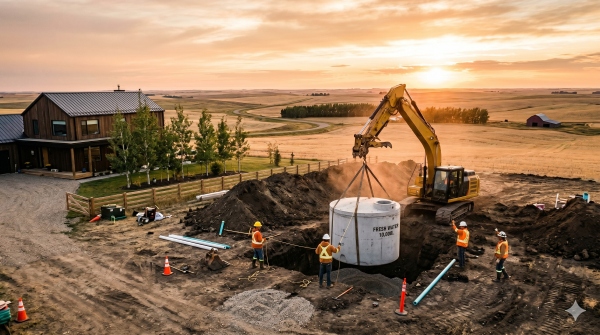
Grade and compact to support full tank mass – both when filled. A 10,000 L tank plus backfill can top 15,000 kg. X geotechnical input on poor soils.
For buried tanks, dig below the local frost line, which is roughly 1.2 to 2.4 meters and varies by region and elevation. Install base bedding using sand or pea gravel, adhere to manufacturer cover depth restrictions, and control for buoyancy in high water tables.
Redirect roof and surface runoff with swales or French drains. Keep downspouts away. Install a sump or perimeter drain anywhere clay soils trap water.
Coordinate wide-load delivery, crane or telehandler, traffic control if necessary, and staging for backfill, insulation, and heat trace. Verify availability of access widths and turning radius.
System Commissioning
Check tank shell, manway gaskets, vent screens, flexible couplings, heat trace, and pressure switches. Tighten unions and torque flange bolts.
Disinfect with approved chlorine dose, usually 50 to 100 mg/L. Installation and Regulations hold contact time as instructed, then flush until residual is at 0.2 to 0.5 mg/L or per AHS advice.
Test for bacteriological quality (total coliforms and E. Coli) and check pump cycling, pressure range, alarm floats and backflow devices.
Record as-built drawings, serial numbers, valve tags and maintenance steps. Distribute to owners a fill log template, shock-chlorination procedures and a sampling schedule.
Maintaining Your Water Supply

An Alberta fresh water cistern requires consistent attention to remain safe, clean, and dependable. Use a simple checklist: inspect tanks and pumps, track water level and pressure, clean on a set schedule, test water quality, and record every task and result. Be on the lookout for leaks, pump cycling, low pressure, cloudy water, or strange taste. Repair sediment problems quickly, seal cracks, and mitigate contamination hazards immediately. Record dates, readings, and invoices in a maintenance log.
Routine Inspections
Inspect the tank shell, roof and base for cracks, frost heave or UV wear. Be on the lookout for damp soil, rust stains and slow drips on fittings and valves. Listen for short-cycling pumps and record pressure swings below the normal 200 to 400 kPa range.
Check access caps and manways for tight seals. Gaskets must rest flush and there should be no spaces. Liners must lie flat with no folds that capture sludge. Make sure screened vents keep out insects and small animals.
Check the water. Our aim is clear water with no odor. Fine silt or green films indicate sediment or algae. Check for scale build-up around the inlet or on the liner.
Check that the pressure tank’s pre-charge (pump off, tank empty) is approximately 20 kPa less than the switch cut-in. Test control switches for cut in and cut out. Check your water supply. Open a hydrant and observe for consistent flow, free of air spurts.
Scheduled Cleaning
Schedule a professional clean at least once per year, or sooner after floods, wildfire ashfall, new well work, or taste shifts. It minimizes biofilm, decreases chlorine demand and provides pump protection.
Pump out the cistern, then clean sludge from the floor and corners by vacuum. Clear grit from the inlet diffuser and float valve. Inspect the liner and repair pinholes prior to refilling.
Disinfect with an appropriate chlorine solution at approximately 50 mg/L on surfaces. Leave in for 30 to 60 minutes, then rinse out until the smell dissipates. Back in service after refill, flush through taps and conduct a clean bacteriological test.
Water Testing
Alberta health bottles, chain-of-custody steps. Sample post-first draw-off flush, do not touch caps, keep samples cool.
Test for total coliforms, E. Coli, turbidity and, as appropriate, nitrates and metals. Contrast findings with provincial private water systems guidelines.
If results don’t meet standards, shock chlorinate, seal entry points and re-test. Record dates, lab slips, results and actions. After any contamination event, perform follow-up tests over one to two weeks.
The Future of Water Storage
Climate shifts, rural development growth and tighter safety regulations are driving Alberta to smarter, cleaner, and more resilient cistern systems engineered for long service in cold, variable weather.
Advances in tank materials, filtration technology, and water management strategies
Tank bodies extend beyond traditional polyethylene to cross-linked PE for greater crack resistance, fiberglass for low weight and simple installation, and epoxy-lined steel for high-volume locations. Insulated jackets and buried designs reduce freeze risk in winters that go beyond -20°C. Modular panels allow sites to drop in 5 to 10 cubic meters blocks as demand builds, not a full exchange. Inside the tank, food-grade coatings and smooth seams reduce biofilm and accelerate cleanouts. On the treatment side, multi-barrier setups are now common: 5 to 20 micron sediment prefilters, activated carbon for taste and organics, and UV units with a 40 mJ/cm² dose or more for disinfection without chemicals. Where source water changes, small ultrafiltration at 0.02 micron levels out turbidity. Smart controls connect level sensors, leak notifications, and flow meters to shutoff valves, sending information to a phone app. A farm can detect a slow night leak or monitor daily draw to schedule truck deliveries. Solar-powered pumps with variable-speed drives reduce start-up surge and extend pump life.
Anticipate growing demand for reliable water systems in rural and remote areas of Alberta
Remote homes, mini-lodges, and farms can be located miles from treated supply lines and experience hauling backlogs during storms or road bans. Cisterns ranging from 10 to 30 cubic meters with freeze-safe fittings maintain tap water stability for families and livestock. Oilfield camps and wildfire-response bases need fast-deploy units that meet potable standards and can be quickly sanitized between moves. Indigenous and northern communities prefer systems that are easy to service on-site, with spare parts that ship quickly and do not require specialty tools.
Promote sustainable practices such as rainwater harvesting and efficient irrigation
Rainwater off barn or shop roofs can replace trucked water for non-potable uses. First-flush diverters, leaf screens, and lined gutters shield quality prior to storage. For yards and shelterbelts, drip lines and soil moisture probes schedule watering in line with root demands, while pressure-regulated emitters maintain consistent flow. When you pair harvested water with low-flow fixtures in your home, it takes less draw on your cisterns year-round.
Position your business as a leader in innovative, dependable water storage solutions for Albertans
Offer site assessments that size tanks by real use patterns, winterization plans that cover burial depth and heat trace, and service packages with scheduled filter swaps and UV lamp checks. Stock modular tanks, NSF-certified filters, and remote monitors that work offline during outages. Train local installers, publish clear O&M guides, and keep a 24/7 support line for leaks, pump faults, or freeze-ups. Back it with transparent warranties and parts on hand.
Conclusion
Freshwater cisterns provide Alberta homes reliable water in droughts and deep freeze. The arrangement is obvious. Size the tank for yourself. Select secure segments. Observe local regulations. Maintain a spruce lid on maintenance. Little jobs on time beat big fixes later.
To estimate expenses, consider parts and labor. For instance, a 10,000 L tank, food grade liner, frost-proof lines, and a rudimentary UV unit. Include a basic test kit. Pick a rinse date each spring. Log every filter replacement. Note meter reads every month.
To reduce risk, install level alarms and a backup feed. In farm areas, establish a fenceline to protect the tank.
Ready to chart your next move? Take our cistern checklist and price guide to begin.
Frequently Asked Questions
What are the main benefits of a freshwater cistern in Alberta?
A cistern provides consistent water in droughts and isolation. It minimizes dependence on wells or trucked water. You regulate quality with appropriate filtration and disinfection. Systems may scale to homes, farms, or businesses. It provides redundancy in the face of supply interruptions.
How does a freshwater cistern system work?
Rain or delivered water captures in a sealed tank. Pre-filters catch dirt. A pump forces water through microfiltration and disinfection, usually UV. A pressure tank maintains consistent flow to the fixtures. Monitors check levels and quality. Overflow and vents safeguard the system.
What size cistern do I need for Alberta conditions?
Begin with daily consumption, typically 150 to 250 liters per individual. Then multiply that by 30 to 60 days for buffer. Take into account roof area, rainfall, and delivery schedule. Most rural homes are 5,000 to 15,000 liters. A professional can right-size based on climate, demand, and code.
Are there Alberta regulations for installing cisterns?
Yes. Local municipalities establish regulations concerning permits, setbacks, and backflow prevention. Plumbing is to provincial codes. Potable systems require food grade tanks and certified disinfection. Be sure to check with your municipality and Alberta Health Services before design and installation.
What maintenance does a cistern require?
Check monthly for leaks and level. Clean pre-filters every 1 to 3 months. Pump services and UV occur yearly. Disinfect the tank every 6 to 12 months or after contamination. Test water quality regularly, particularly for coliforms. Maintain a clean roof and gutters for rain capture.
Can cistern water be safely used for drinking?
Yes, designed and treated appropriately. Food-grade tanks, sealed lids, first-flush diversion, sediment and carbon filters, and certified UV or chlorination systems. Test water from time to time. Observe manufacturer lamp change and filter replacement schedules.
What trends are shaping the future of water storage in Alberta?
Anticipate intelligent sensors, remote management, and leak warnings. Superior tank components will prolong life. Integrated rainwater and greywater systems will be more efficient. Incentives and stricter water-use policies might increase adoption. Designs will be oriented toward resilience to drought and extreme weather.
Still exploring your options? Check services from Wastewater Solutions to learn more.
Site Evaluation and System Design
For additional information, you can also browse the following resources.